
Iron Deficiency vs Anaemia: Why a "Normal" Blood Test Can Miss Low Iron
You've been exhausted for months. Your bloods came back and someone said the magic words: "Your iron's fine."
Except your hair is coming out in the shower, your brain feels like it's buffering, and you're seriously considering lying down on the office floor at 3pm.
Here's the thing: "fine" depends entirely on where the line is drawn. And this year, one of the world's leading haematology bodies moved it.
This is Week 2 of my Iron Series, and we're starting with the basics almost nobody explains properly: the difference between iron deficiency and anaemia, how common they are, and why your results might not be telling you the whole story.
"I'm not anaemic, so my iron must be okay... right?"
Not quite. Iron deficiency and anaemia are related, but they're not the same thing.
Iron deficiency means your iron stores are running low.
Anaemia means your haemoglobin, the protein in your red blood cells that carries oxygen, has dropped. Iron deficiency is the most common cause of anaemia [3].
Iron deficiency | Iron deficiency anaemia | |
|---|---|---|
What's happening | Iron stores are running low | Stores are so depleted that haemoglobin drops |
Key blood markers | Ferritin (plus transferrin saturation) | Low haemoglobin, alongside low iron stores |
How it can feel | Tired, foggy, hair shedding, restless legs, catching every bug going around | All of that, often more pronounced |
The sneaky part is that you can be iron deficient without being anaemic, and the symptoms often show up first. Fatigue, brain fog, lowered immunity, restless legs, hair loss and poor circulation are the classic ones [3][4]. That's why "your haemoglobin is normal" and "I feel terrible" can both be true at the same tim
How common is this, really?
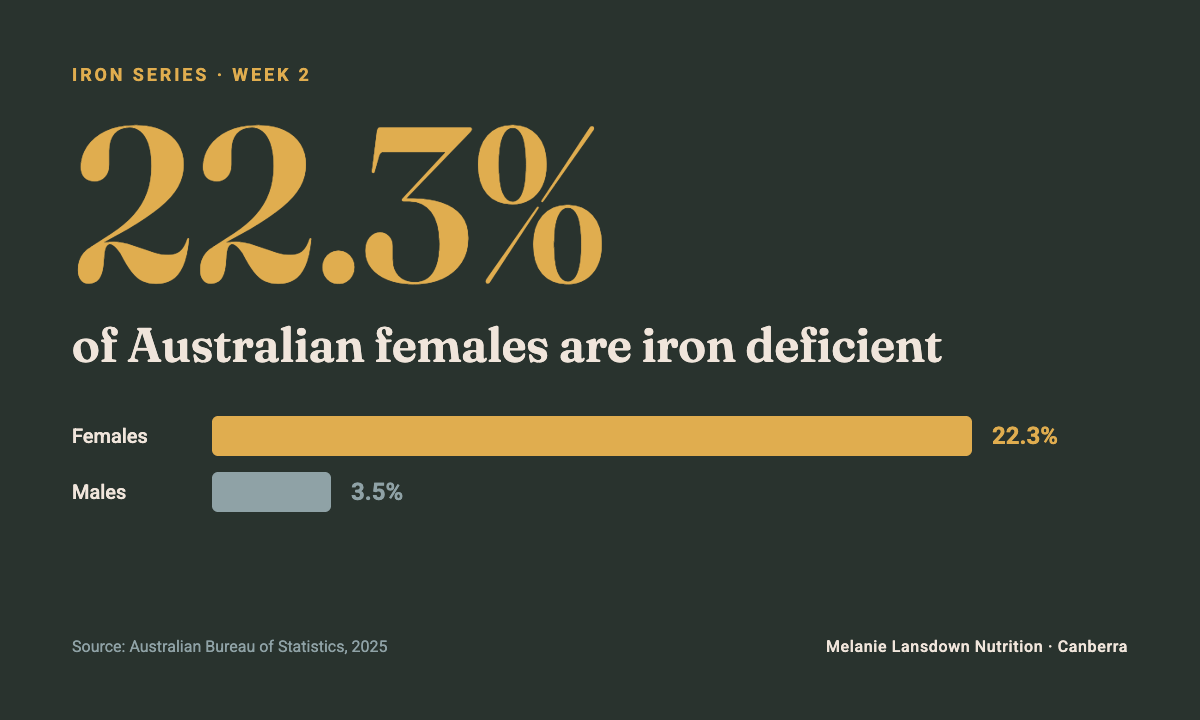
More than you'd think. Iron deficiency is the most common micronutrient deficiency in the world, and roughly a quarter to a third of the global population is estimated to be anaemic [3]. In Australia, 22.3% of females are iron deficient, compared with 3.5% of males [2]. Whether you're in Canberra or Cairns, that's a lot of tired women.
In clinic, it's one of the most common patterns I see, from slightly suboptimal levels right through to iron deficiency anaemia. Plenty of women have been told for years that it's just life: busy, stressed, getting older.
My ferritin was 'normal'. So why do I feel like this?
Ferritin is the protein that stores iron, and a ferritin test is the most powerful single test for iron deficiency [5]. But what counts as "normal" depends on who's drawing the line.
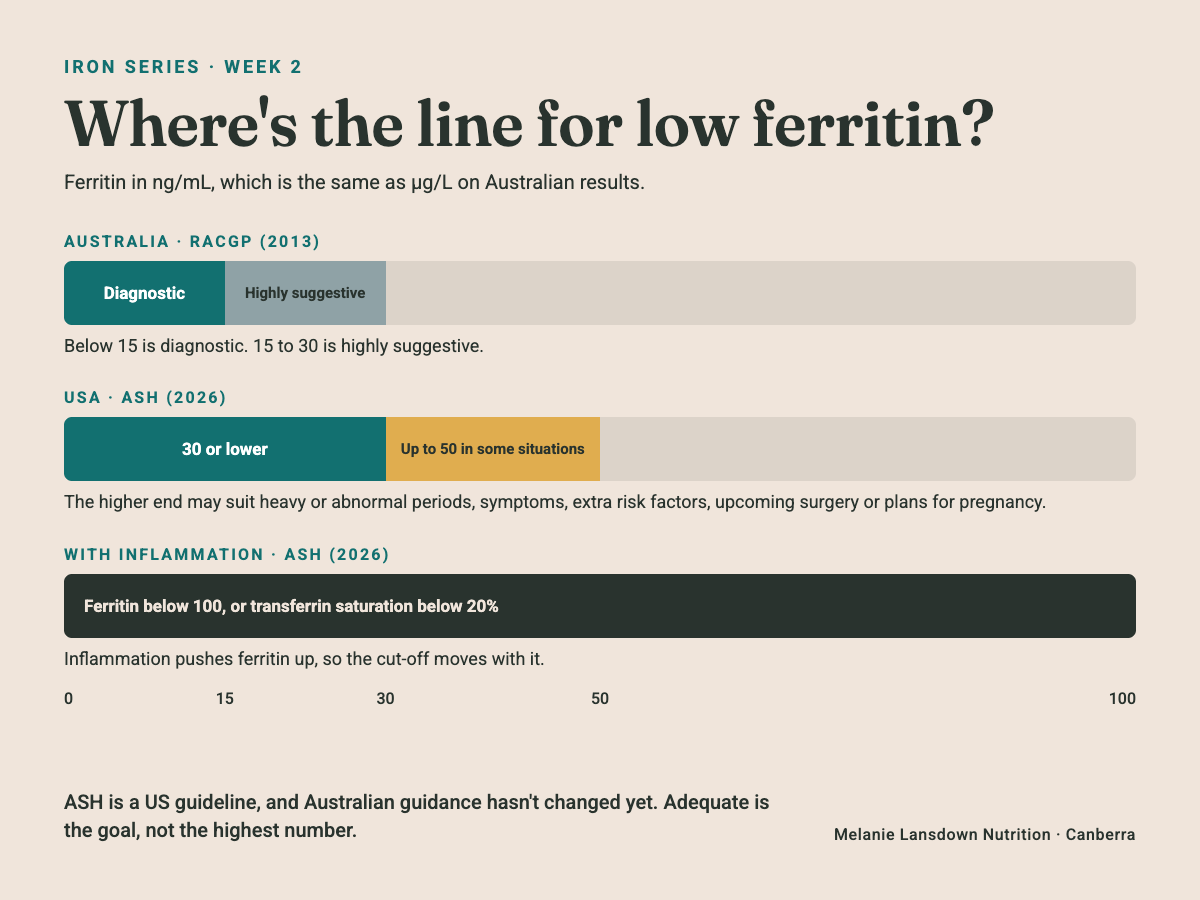
In Australia, RACGP guidance treats a ferritin under 15 µg/L as diagnostic of iron deficiency, and 15 to 30 µg/L as highly suggestive [5]. Lab reference ranges vary, and a result in the teens or twenties has too often been waved through with "it's in range."
This year, the American Society of Hematology (ASH) published its first guideline on diagnosing iron deficiency, and it recommends higher ferritin thresholds [1]:
Adults, including menstruating women: ferritin of 30 ng/mL or lower, up from the 15 traditionally used [1][5]. (ng/mL is the same as the µg/L on your Australian results.)
Up to 50 ng/mL may be appropriate with heavy or abnormal periods, symptoms, extra risk factors, upcoming surgery or plans for pregnancy [1].
With inflammation: ferritin below 100 ng/mL or transferrin saturation below 20% [1].
This is a US guideline, and I haven't seen Australian guidance change yet, so I wouldn't expect your lab report to look different tomorrow. But it gives me real hope. Many practitioners, myself included, have long looked closely at that grey zone, and it's encouraging to see it recognised in a major guideline. The whole point is catching low iron before anaemia sets in.
A quick reality check: the new numbers are about spotting deficiency, not chasing a high ferritin. Your body has no efficient way to get rid of extra iron [9], and higher ferritin levels have been linked with a greater risk of type 2 diabetes [7] and some pregnancy complications [8]. Adequate is the goal. More isn't better.
Can my ferritin look fine when I'm actually low?
Yes, and inflammation is the usual reason. Ferritin rises with inflammation and infection, so it can look normal, or even high, while your body can't actually get at its iron. Inflammation switches on a hormone called hepcidin, which locks iron away regardless of how much you've stored [6]. It's often called functional iron deficiency, or anaemia of inflammation, and it's why a single ferritin number should never be read in isolation.
A fuller iron picture looks at:
Ferritin (your stores)
Transferrin saturation (how much of your iron transport system is actually loaded)
Serum iron and transferrin (serum iron on its own shouldn't be used to diagnose iron deficiency [5])
A full blood count, including haemoglobin
CRP, to check for inflammation
Iron also doesn't work alone. B12, folate, copper and vitamin A all play a part in how well your body uses it, and they get their own article later in this series.
Okay. So what do I do with this?
Get the actual numbers. Ask for ferritin, transferrin saturation, a full blood count and CRP, and ask for your results, not just "normal."
Don't guess with supplements. Because your body can't excrete excess iron [9], it's best to test first and take iron with guidance.
Ask why. Low iron is rarely the whole story. Intake, absorption, gut health, inflammation and blood loss can all play a role, and that's exactly what we dig into next in the series.
Start with food. Need somewhere to begin? My [freezer-stash breakfast sandwich](URL: iron breakfast sandwich blog post) is packed with iron, and there's a pregnancy-friendly swap too.
Bring your results to your GP or practitioner as a conversation starter. You're not challenging anyone, you're helping them see the whole picture.
Coming up in the Iron Series: another recipe, then "What's actually driving your low iron" (hint: it's often not just your period).
Iron deficiency vs anaemia: your questions answered
What is the difference between iron deficiency and anaemia? Iron deficiency means your body's iron stores are low. Anaemia means your haemoglobin has fallen below the normal range, and iron deficiency is its most common cause. You can be iron deficient without being anaemic.
Can you be iron deficient with normal haemoglobin? Yes. Stores can run low well before haemoglobin drops, and symptoms like fatigue, brain fog and hair loss can appear during this stage.
What ferritin level is considered iron deficient? Australian RACGP guidance treats ferritin below 15 µg/L as diagnostic and 15 to 30 µg/L as highly suggestive. In 2026 the American Society of Hematology recommended a threshold of 30 ng/mL or lower for adults, and up to 50 in some situations. Lab reference ranges vary, so talk through your results with your practitioner.
Can ferritin be normal when iron is low? Yes. Ferritin rises with inflammation and infection, which can hide iron deficiency. Transferrin saturation and CRP help give a clearer picture. ASH suggests ferritin below 100 ng/mL or transferrin saturation below 20% may indicate iron deficiency when inflammation is present.
Should I take an iron supplement without testing? No. Test first always. The body has no efficient way to remove excess iron, and low iron has different causes that call for different approaches.
References
American Society of Hematology. (2026). ASH 2026 guidelines for diagnosis of iron deficiency. Blood Advances. https://www.hematology.org/newsroom/press-releases/2026/ash-sets-new-standards-for-diagnosing-iron-deficiency
Australian Bureau of Statistics. (2025). Iron: Intergenerational health and mental health study: concepts, sources and methods. https://www.abs.gov.au/statistics/detailed-methodology-information/concepts-sources-methods/intergenerational-health-and-mental-health-study-concepts-sources-and-methods/2020-24/biomedical-collections/iron
McLean, E., Cogswell, M., Egli, I., Wojdyla, D., de Benoist, B. (2009). Worldwide prevalence of anaemia, WHO Vitamin and Mineral Nutrition Information System, 1993–2005. Public Health Nutrition. https://www.cambridge.org/core/journals/public-health-nutrition/article/worldwide-prevalence-of-anaemia-who-vitamin-and-mineral-nutrition-information-system-19932005/E201EDE33949AF3D632F6596052FCF8F
Zhang, G. D., Johnstone, D., Leahy, M. F., Olynyk, J. K. (2024). Updating the diagnosis and management of iron deficiency in the era of routine ferritin testing of blood donors by Australian Red Cross Lifeblood. Medical Journal of Australia. https://www.mja.com.au/journal/2024/221/7/updating-diagnosis-and-management-iron-deficiency-era-routine-ferritin-testing
RACGP. (2013). Patient blood management: the GP's guide. Australian Family Physician. https://www.racgp.org.au/afp/2013/may/patient-blood-management
Weiss, G., Ganz, T., Goodnough, L. T. (2019). Anemia of inflammation. Blood. https://www.ncbi.nlm.nih.gov/pmc/articles/PMC6536698/
Jiang, L., et al. (2019). Sex-specific association of circulating ferritin level and risk of type 2 diabetes: a dose-response meta-analysis of prospective studies. Journal of Clinical Endocrinology & Metabolism. https://academic.oup.com/jcem/article/104/10/4539/5487351
Ehsani, A., et al. (2026). Investigation of the association between maternal serum ferritin levels and preterm delivery: a systematic review and meta-analyses. https://link.springer.com/article/10.1007/s00404-026-08336-z
Wallace, D. F. (2016). The regulation of iron absorption and homeostasis. https://pmc.ncbi.nlm.nih.gov/articles/PMC5198508/
This article is general information, not personalised medical advice. If you're experiencing ongoing fatigue or other symptoms, speak with your GP or healthcare practitioner about testing that's right for you. Please don't start iron supplements without testing and guidance.


