
Why Your Gut Has Gone Rogue in Midlife — and How Fibre Helps
If you've been following this series, by now you know carbs aren't the enemy, you know your way around the three types of fibre, and you understand why your energy nosedives at 3pm. So let me leave you with the piece I find most fascinating of all.
Fibre isn't just about digestion.
It's in a constant conversation with your hormones. And in midlife, that conversation matters more than it ever has. Let me introduce you to the reason why, a rather wonderful thing called your estrobolome.
Meet your estrobolome
Tucked inside your gut is a community of bacteria whose particular job is helping to manage your oestrogen. Collectively, they're known as the estrobolome.¹
Here's how it works. Your liver processes oestrogen and packages it up to be sent out of the body via your gut. But certain gut bacteria produce an enzyme (β-glucuronidase, if you like the technical name) that can unpackage some of that oestrogen, sending it back into circulation rather than out the door.¹
Why does that matter? Because it means your gut bacteria have a real say in how much oestrogen stays in your body. When your microbiome is healthy and balanced, this system hums along nicely, helping keep your oestrogen in a comfortable range. When it's out of balance, that regulation can tip too far in either direction - too much oestrogen recirculated, or too little supported.¹
In other words: your gut isn't just digesting your lunch. It's part of your hormonal thermostat.
So what's fibre got to do with it?
Everything, as it turns out.
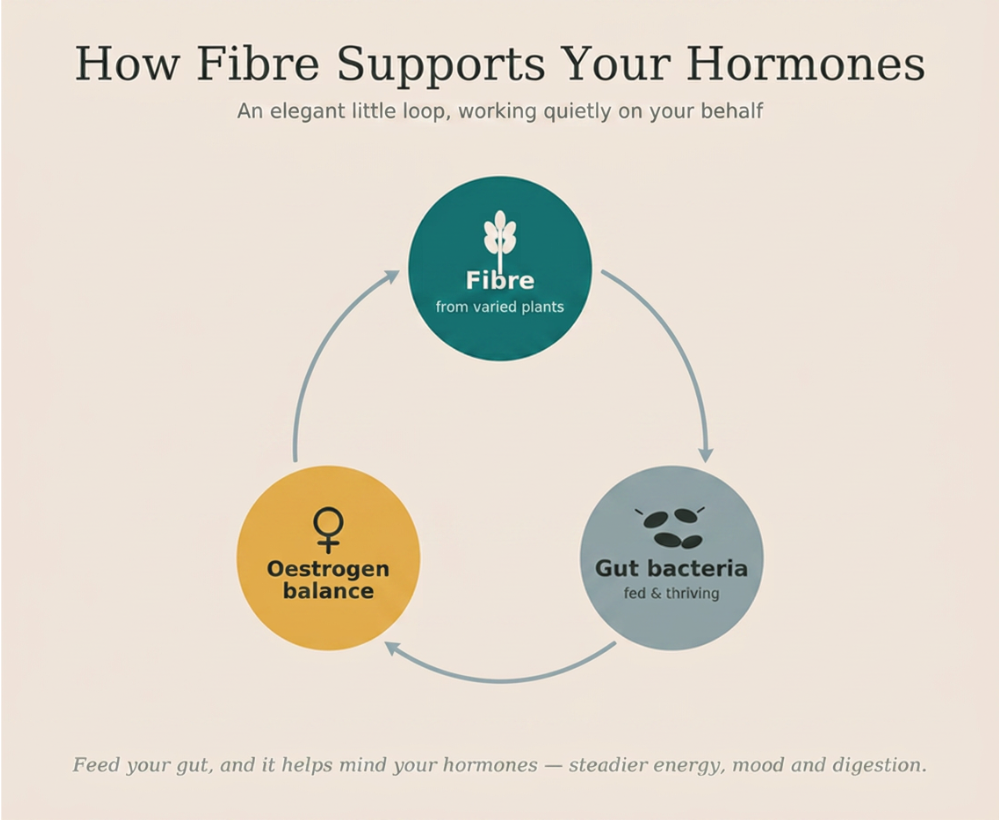
Your gut bacteria don't work for free. They need feeding, and their favourite food is fibre. When you eat a good variety of plant fibres, your beneficial bacteria ferment them into helpful compounds called short-chain fatty acids, which keep the lining of your gut strong and your whole microbial community thriving.²
A well-fed, diverse microbiome is a well-functioning one. And a well-functioning microbiome is far better equipped to keep that oestrogen-regulating system balanced and to escort any excess oestrogen out of the body as intended, rather than letting it linger.¹
So the humble act of eating more plants isn't just good for your digestion. It's supporting the bacteria behind the scenes, that help keep your hormones steady. Fibre feeds your gut; your gut helps mind your hormones. It's an elegant little loop.
Why this matters so much more in midlife
Here's the part that makes fibre non-negotiable from your 40s onwards.
Research shows that gut microbiome diversity tends to decline during the menopausal transition, at the very same time your ovarian oestrogen is falling.³ And these two things interact. A less diverse microbiome has a reduced capacity to support healthy oestrogen recirculation, which can compound the effects of the oestrogen you're already losing.⁴
Studies comparing post-menopausal and pre-menopausal women have found the post-menopausal gut is often lower in the very bacteria that produce those beneficial short-chain fatty acids.³ So just as your body could most use a well-functioning gut, it's under a bit more pressure to keep one.
The good news in all of this? Fibre is one of the most direct levers you have. You can't rewind your ovarian oestrogen, but you can feed and support the microbiome that helps you make the most of the oestrogen you have. That's real, tangible influence over how you feel through this transition.
And it works both ways: how your hormones affect your gut
So far we've talked about how your gut influences your hormones. But the traffic runs in both directions. This is the part that explains why so many women suddenly find their digestion goes a bit rogue in perimenopause, seemingly out of nowhere.
Oestrogen and progesterone don't just affect your cycle. They have receptors throughout your digestive system and quietly influence how it works. So as these hormones fluctuate and fall, your gut feels it - in a few specific ways:
Things slow down. Oestrogen and progesterone help regulate gut motility, the muscular movement that keeps everything travelling through at a good pace. As they decline, that movement can slow, which is why constipation, sluggishness and a feeling of never-quite-finished can turn up in midlife even when nothing about your diet has changed.⁶
Your microbiome shifts. Falling oestrogen is linked with a change in the balance of your gut bacteria and a drop in diversity - often a loss of some of the beneficial strains.³ Less diversity tends to mean more bloating and less comfortable digestion.
Your gut lining gets a little more vulnerable. Oestrogen helps keep the gut barrier (the wall between your intestines and your bloodstream) strong and intact. As oestrogen dips, that barrier can become more permeable, which can let through more inflammation and discomfort.¹
Your gut becomes more reactive to stress. The gut and brain are in constant two-way conversation along what's known as the gut–brain axis. Shifting hormones can heighten how your body perceives and responds to stress, so even small stressors can show up as very physical gut symptoms - bloating, tightness, urgency.⁶ (If you've noticed your digestion suddenly has opinions about your stress levels, you're not imagining it.)
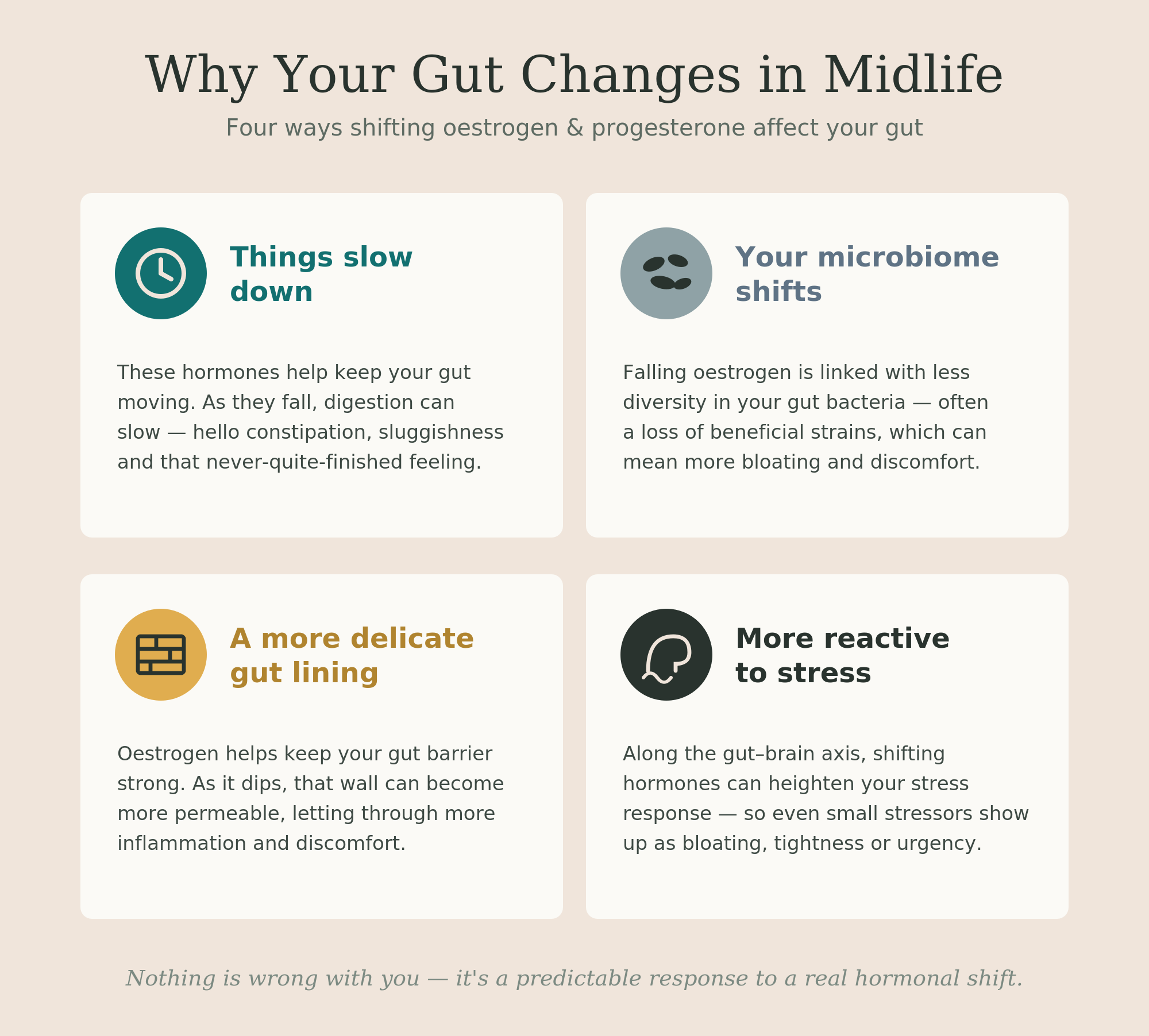
Put it all together and it's no wonder the perimenopausal gut can feel like it's developed a mind of its own. None of this means something is wrong with you. It's a predictable response to a real hormonal shift (I've written more about supporting your body through these hormonal changes too). And it's yet another reason that supporting your gut, gently and consistently, pays off so well right now.
The immune piece (a quick but important aside)
There's one more reason your gut deserves top billing in midlife.
A large proportion of your immune system (often cited as around 70%) lives in and around your gut. Those short-chain fatty acids fibre helps produce don't just feed your gut lining; they support a calm, well-regulated immune system.² This is part of why gut health comes up so often in conversations about autoimmune conditions like Hashimoto's, which disproportionately affect women in midlife - a connection I've written about elsewhere.
I won't overstate it — fibre is not a treatment for autoimmune disease, and anyone promising that isn't being straight with you. But a well-nourished gut is genuinely foundational to a well-regulated system. And that's worth taking seriously.
An honest word on the science
Because I'd rather be trusted than trendy: this is an exciting and fast-growing area of research, but it's still emerging. The mechanisms are well established and biologically sound, and the observational evidence is genuinely promising — but we don't yet have all the large, long-term human trials we'd love to have.¹
So I'm not here to promise fibre will fix your hormones. What I can say, with real confidence, is this: supporting your gut with plenty of varied fibre is one of the safest, most foundational, most evidence-backed things you can do for your health in midlife, with benefits that ripple out to your hormones, your immune system, your digestion, and far beyond. That's not a fad. That's a foundation.
What this actually means for your plate
Happily, supporting your estrobolome looks exactly like eating well for your gut - which we covered in the fibre post. A quick recap, with hormones in mind:
Diversity is the goal. Different bacteria thrive on different fibres, so a variety of plants matters more than piling up one. The often-cited target is around 30 different plant foods a week - vegetables, fruit, whole-grains, legumes, nuts, seeds, herbs and spices all count. It's less daunting than it sounds once you start tallying.
Aim for a genuinely good fibre intake. As I've said before, I'm generally after at least 30g+ a day with the women I work with, comfortably above the standard guideline, and where I tend to see the real shifts.
Include the gut-loving stars. Resistant starch (cooked-and-cooled potato or rice, slightly green bananas), soluble fibre (oats, legumes, apples), and a little fermented food (yoghurt, kefir, sauerkraut, kimchi) all give your microbiome something to work with.
Build up gently, and drink your water. Same rule as always - your gut adjusts best when you increase fibre gradually. (And if you've tried every gut tip going and felt worse, it's worth knowing standard gut advice doesn't suit everyone.)
None of this is about a rigid plan. It's about nourishing the clever system that's working away on your behalf.
Small, consistent changes. Big, compounding rewards.
The bottom line
Fibre has spent years being framed as the boring nutrient, the thing your grandmother nagged you about. But it's turning out to be one of the most powerful players in women's midlife health: feeding the gut bacteria that help regulate your hormones, supporting your immune system, and steadying you from the inside out.
Your body isn't working against you in midlife. It's asking for different support than it used to and more fibre, more variety, added gently, is one of the most generous things you can offer it.
That's the whole series in a nutshell, really. Not another diet. A better, kinder, more informed way of feeding the body you have now.
Thank you for reading along. I hope it's left you feeling a little more informed, a little more capable, and a lot less afraid of your dinner.
Ready to feel like yourself again?
If everything in this series has resonated and you'd love someone in your corner to help you put it into practice - properly, and for your body - I'd love to help.
Book a free 15-minute discovery call and let's work out where to start.
References
Baker JM, Al-Nakkash L, Herbst-Kralovetz MM. Estrogen–gut microbiome axis: physiological and clinical implications. Maturitas. 2017;103:45–53. doi:10.1016/j.maturitas.2017.06.025
Better Health Channel (Victoria). Dietary fibre. Available at: betterhealth.vic.gov.au
Estrogen and Metabolism / gut microbiome diversity in the menopausal transition. PMC (National Library of Medicine). Available at: pmc.ncbi.nlm.nih.gov/articles/PMC10269676
healthdirect Australia. High-fibre foods and diet. Available at: healthdirect.gov.au/high-fibre-foods-and-diet
National Health and Medical Research Council (NHMRC) / Eat For Health. Dietary fibre. Available at: eatforhealth.gov.au
Gut–brain communication in menopause: insights into neuroendocrine and microbiome interactions. Proceedings of the Nutrition Society (Cambridge University Press). 2026. Available at: cambridge.org/core/journals/proceedings-of-the-nutrition-society
This article is general information only and isn't a substitute for personalised advice. If persistent energy crashes, cravings or low energy are affecting your daily life, that's worth looking into properly — book in and we'll get to the root of it together.


